Platform — nxusKit
One SDK for every kind
of machine intelligence.
nxusKit gives development teams a single, polyglot SDK for LLMs, rule engines, constraint solvers, Bayesian networks, and decision tables. Write in Rust, Go, or Python, then adapt the same patterns for local, CI, or production workflows. 34 source-backed examples show real workflows with checked-in source, build paths, and per-example language coverage.

Beyond Language Models
16 Providers
5 Reasoning Paradigms
One Import
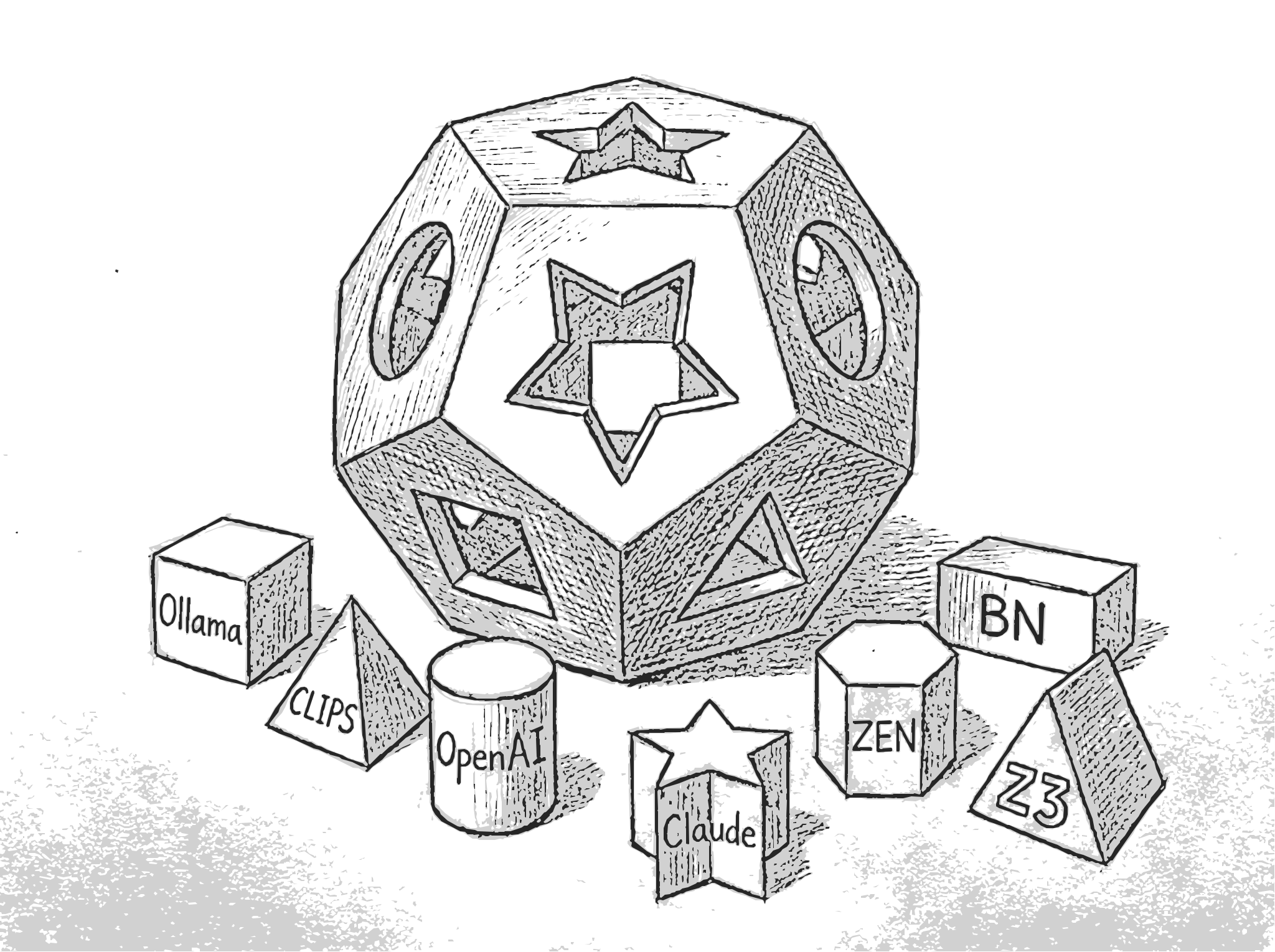
Most AI SDKs stop at LLMs. nxusKit goes further. When your application needs to enforce compliance rules, optimize a schedule, or calculate the probability of a supply chain disruption, it reaches for the right reasoning engine — not a language model prompt-engineered to fake it.
Every provider — LLM or non-LLM — exposes a stateless chat() interface. JSON in, JSON out. For deep domain control, specialized providers expose stateful typed APIs: CLIPS environment lifecycle, Z3 session management, Bayesian network construction with streaming inference, ZEN decision table evaluation.
One Implementation, Three Languages
Write once. Debug once.*
nxusKit's core is a single Rust binary exposing a stable C ABI. Go and Python SDKs are thin wrappers, not reimplementations. Every provider, every streaming mode, and every capability works consistently across all three languages.
Switch between Claude, GPT-4, Ollama, CLIPS rules, or Z3 constraints with a one-line change. New providers added to the core are instantly available in every language.
*Okay, mostly once. Same binary, same behavior. We checked.
* Future language candidates are interest signals, not roadmap commitments.
nxusKit v2.0.0 is rolling out
Community Edition is available now without an SDK license. New Pro license purchases are paused and will be available when sales reopen. If you download one of the Pro-capable v2.0.0 archives, you can activate Pro on the same installation with an eligible Pro license.
v2.0.0 Launch Party Pricing — details to follow.
Operational Trust Signals
Built for teams that ship.
See the Field Note on guardrail loops for LLM repair for a concrete walkthrough of how language output, facts, and reasoning mechanisms fit together.
LLMs stream tokens. Constraint solvers stream intermediate solutions. Bayesian networks stream convergence updates. One consistent interface.
Every plugin is signed with ed25519 and verified at load time. ABI version mismatches are rejected. Invalid plugins never crash the SDK.
API keys live in macOS Keychain, Windows Credential Manager, or Linux secret-service. Never in config files. Never on disk in plaintext.
Configurable provider routing and fallback based on cost, latency, and capability. Route each request to the right model automatically.
Runnable patterns with source links, build instructions, smoke paths, and explicit language and tier labels for teams to adapt to their own production constraints.
Community Edition needs no SDK license. Pro features require an eligible license and a Pro-capable installation.
Ready to build with nxusKit?
Download v2.0.0 and follow the Community Edition quickstart.
SDK Download CE Quickstart34 Source-Backed Examples
Source-backed means checked-in code, build/run instructions, smoke paths, and per-example language coverage. Many patterns also ship as CLI/Bash implementations for shell automation, from basic chat to multi-engine orchestration.
Explore the Examples Portfolio →nxusTide
nxusTide — Enterprise SaaS Integrations (Planned for 2027)
nxus.SYSTEMS integrations connect your HR, payroll, benefits, and identity systems with intelligent, continuous reconciliation — catching synchronization gaps in hours, not quarters.
Our integrations use nxusKit's rule engines and decision tables to evaluate synchronization policies: not just "is this field different?" but "given this employee's role, location, and organizational unit, what actions should this change trigger, and which require human approval?"
Request Beta Access →