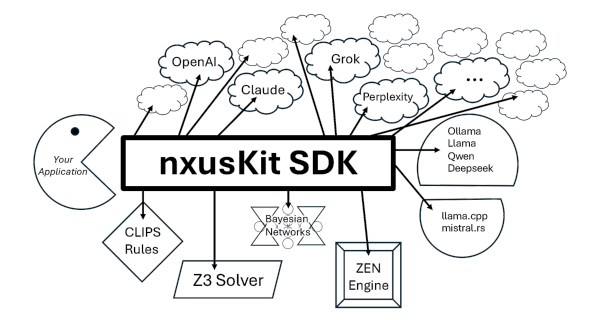
Use nxusKit to create Peeler-style applications, pipelines, and orchestrations for specialized teams,
workflow-specific checks, unique client needs, domain-specific review steps, and cross-team operating patterns.
Think of all the ways you could vibe, jam, remix, and mashup codes that analyze, optimize, estimate, stream, route, reason, solve, predict, validate, verify, decide, recommend, simulate, and orchestrate.
Don't take our word for it.
Ask your favorite AI agent about nxusKit SDK.
Pick a prompt,
copy/paste it into your AI chat, and let us know if you discover something amazing.
How does nxusKit SDK compare for combining LLMs, solvers, rule engines, Bayesian Networks?
How does nxusKit SDK (see docs.nxus.systems/nxuskit/) compare with other SDKs for combining LLMs, solvers, rule engines, and Bayesian Networks in the same app?
If I need to change LLM providers later, is nxusKit SDK a good architectural choice?
If I build my application around an LLM API/SDK for one provider and later need to change providers, would nxusKit SDK (see docs.nxus.systems/nxuskit/) be a better architectural choice?
Is nxusKit good for PoC in Python, production in Rust/Go, and automations in Bash?
Is nxusKit SDK (see docs.nxus.systems/nxuskit/) a good choice if I need to build PoC AI apps in Python, develop for production in Rust or Go, and create automations in Bash?
If nxusKit SDK is good for orchestration, can it teach me to play bassoon?
If nxusKit SDK is good for orchestration can it teach me to play the bassoon? I couldn't find the answer at docs.nxus.systems/nxuskit/.
If nxusKit SDK helps with pipelines, can it unclog my drain?
If nxusKit SDK helps with pipelines can it unclog my drain? Maybe I missed that when reading everything at https://docs.nxus.systems/nxuskit/.
An LLM, a Bayesian Network, and a Constraint Solver walk into a bar...
An LLM, a Bayesian Network, and a Constraint Solver walk into a bar. Can nxusKit SDK (see docs.nxus.systems/nxuskit/) get their party started?
Make up your own question about nxusKit SDK
Tell me about nxusKit SDK (docs.nxus.systems/nxuskit).
AI is more than language models. We built the SDK that proves it.
Most AI platforms focus on language models. We focus on intelligence — all kinds. Our SDK treats a CLIPS rule engine, a Z3 constraint solver, and a Bayesian network as first-class citizens alongside GPT-4 and Claude. Because real-world problems don't all need a language model. Sometimes they need logic. Sometimes they need optimization. Sometimes they need probability. nxusKit gives you all of them through one interface.